


Wednesday, June 27, 2018
Haywire Custom Guitars #1 Guitar Players Blog: How Do You Assist Customers Who Are Having Issues ...
Haywire Custom Guitars #1 Guitar Players Blog: How Do You Assist Customers Who Are Having Issues ...: How Do You Assist Customers Who Are Having Issues With Guitar Strings High Off The Neck? That is a very good question. The short answer ...

How Do You Assist Customers Who Are Having Issues With Guitar Strings High Off The Neck?
How Do You Assist Customers Who Are Having Issues With Guitar Strings High Off The Neck?
That is a very good question. The short answer is, we fix it. The height of the strings from the neck is called,"action". Raising the action or lifting the strings higher off the face of the fret board is quite easy and makes everyone an expert. Most noteworthy, lowering the "action" is one of the most operations performed on a guitars. So, why if raising is easy, as a result, it should be easy to lower too. Sorry, it's a one way street here. That's not how it works-so the short answer gets longer. Lowering action to a customers specs is a very difficult, multi-operational process and skill. This takes training and practice to accomplish properly.Low Action Speaks Louder Than Words
In our article, Action Speaks Louder Than Words, I quote, " Action or feel and guitar string height is most commonly thought of as how high the strings are from the frets.Therefore, it is called string height. Action is a term used to describe how a guitar is adjusted according to how high or low the strings are on the neck which affects how well it plays. A guitar player needs to know how to set action. Furthermore, Finally, if the action is how a guitar plays, specifically the distance of the strings to the fingerboard. The strings can’t sit too high because they’re hard to fret. However, if they’re too low, buzzing occurs. The farther a string must travel pushed down by a players fingertip. Most noteworthy, the higher the action, the sharper the string gets. High action=Sharper notes."standard terminology used by luthiers for a thin wedge under a bolt-on neck is a shim
If a guitar player cannot set the action low enough then it's certainly not a life altering issue. Because we can do it, it's not necessary for the player to do it. Problems arise when the strings sit too high, they’re hard to fret. If they’re too low, buzzing occurs. If string buzz is not an issue then play on! Most guitarists object to "string buzz". It's when the fretted note rattles on the next fret in front of it. It generally does not translate through an amp but players notice it when they play and usually complain about it. Guitar strings high off of the fret board make playing difficult.
One way to achieve lower action; neck truss rod adjustment for strings too high. Consequently, the search for low action begins in the guitar repair shop. In the Haywire Custom Guitar shop we first set the truss rod. A truss rod is an adjustable rod running the length of the guitar neck. It both strengthens the neck and facilitates adjustment of a bowed or humped neck. (see illustration).

Here we begin the search for lower guitar action.
Lowering action to the customers specs is a very difficult, multi-operational process
Being the first step adjusting the truss rod may work. If it doesn't and the strings are still not low enough, we go down the list. The next step in the search is to cut the top off of every fret to ensure no obstacles for the strings. This step is called fret leveling. In addition to cutting off the tops there are inherently two more steps to that process.Fret leveling therefore is a three step process with guitar strings high. After the tops of the frets are leveled, they need to be re-crowned. What is re-crowning? It simply brings the roundness back to the top of the frets from the flatness leveling causes. This step causes the need to invoke the last step of polishing the frets. The re-crowning process causes the fret to become rough and not smooth like a great feeling guitar needs to be. Hence, polishing to bring the fret back to it's original luster is required. Therefore, "a very difficult, multi-operational process" becomes more valid.
adjust the angle or pitch of the neck
If the following steps fail to make a meaningful change if issues with guitar strings too high, we need to look elsewhere. We need to go to another technique for lowering action. Let's look at shim placement to adjust the angle or pitch of the neck. Guitarists erroneously believe that all guitar necks are interchangeable. This is the part of our job that takes up most of our time. It's called: debunking myths believed by all guitar players. Especially relevant is the fact that guitarists hold onto these like a dog grabs a bone. They are quite content believing what they read on a guitar forum because it must be true. Now, that I have lost 75% of my readers here let's move on. Now that we who are left are all on the same page the next step will get us closer to lower action.guitar strings high
If after installing the neck and adjusting the truss rod you see better action is necessary, use a shim. You can set your action string height better and lower when you use a shim. Most likely, will need one, because the likelihood of a new bolt-on neck fitting exactly right just doesn’t happen. It’s up to you or us at the custom shop to “make it happen”. We'll reduce the height when guitar strings high off the neck are problematic.Why are guitar neck shims needed for new neck installations?
What is the purpose of a guitar neck shim? To adjust the angle or pitch of the guitar neck. Why would you need to adjust the angle or pitch of the neck? Remember.... all guitar necks are not interchangeable. Sure they may fit, but not properly. It is crucial to get the exact neck angle right so that the strings lay in extreme parallel all the way down the neck. Failing the above steps. This is the only remaining way low action can be achieved. Need low action?-call us. You can watch while we do it if you'd like. We'll get it as low as you want it!
Featherlight Swamp Ash Natural Body Guitars For Women
Featherlight Swamp Ash Natural Body Guitars From The Haywire Custom Guitars Custom Shop
Let's address guitars for women.....
Featherlight guitars for women from Haywire Custom shop are much easier to hold and play. At Haywire Custom Guitars we take the classic look of the double and single cutaway guitar and lighten it. We drop the weight by up to 30 percent. As a result, each of our lightweight guitars are six pounds or less. Can you handle it? Many of our Custom Shop featherlight guitars are specifically designed for female players. Women need and want lightweight guitars. Why does no one address their playing needs?well-crafted instrument with design and electronic features and lighter materials
If you are under the assumption that a heavy guitar will sound better than a lighter one, you would be mistaken. Because a guitar lacks weight and heft, it doesn't have to lack tone. Is it possible to find some light woods which provide some great sounding guitars? Can you find a well-crafted instrument with design and electronic features and lighter materials that rival much expensive guitars made from quality materials at a reasonable price?


 Feather light body from Haywire Custom Guitars


You'd like a guitar to be beautiful, of course.
Where can you get a light weight guitar that is a dream to hold and play … for long periods of time. Do you play long gigs? Is your guitar heavy? Would you like to stop taking your shoulder pain medication? These are just some of the question that finally have been addressed in our custom shop. For the last 10 years we have been focused and able to assist female musicians in the quest for a lighter guitar. You'd like a guitar that is beautiful, of course, right ladies?Please remember our female players
Guitars for women need to be very easy, light weight and enjoyable to play. Also, it needs to hold the tuning really well. Because, if you are looking for something to play a variety of different styles without issues maybe you need to look here. Great tones, good looks for someone with back and neck issues or for younger and older players with smaller body frames, the lightness is definitely a huge plus. Have I mentioned women here at all? Yes, let's not forget the ladies. Please remember our female players are smaller and lighter than male counterparts. They especially need something light to play.
Tuesday, June 19, 2018
Care When Adding Roasted Maple Guitar Neck To A Guitar Body
Care When Adding Roasted Maple Guitar Neck To A Guitar Body
Adding A Roasted Maple Guitar Neck Requires Vigilance
Roasted Maple Guitar Neck
Be Careful When Adding A Roasted Maple Guitar Neck. While
there are advantages such as being less expensive when no finish is
required and the fact that the roasting process brings out a beautiful
caramel color in the wood. There are drawbacks when adding a roasted
maple guitar neck.
there are advantages such as being less expensive when no finish is
required and the fact that the roasting process brings out a beautiful
caramel color in the wood. There are drawbacks when adding a roasted
maple guitar neck.
“Roasted Maple” Neck Issues…..
Remember the nature of a roasted maple guitar neck
is to be very brittle. Therefore, look closer at the roasted maple
guitar neck than you normally do other necks, specifically the screw
holes. It’s very interesting but can be a difficult problem if you are
not aware of the characteristics of the roasted wood. Screw threads on the
neck plate screws can strip out in the neck holes. It’s caused by the
roasted wood being so brittle that the insides of the holes are much
more prone to strip out versus an standard kiln dried Maple neck. If you
have ever worked with 100 year old wood then you know what you’re
dealing with. Roasting ages and weakens wood significantly.
is to be very brittle. Therefore, look closer at the roasted maple
guitar neck than you normally do other necks, specifically the screw
holes. It’s very interesting but can be a difficult problem if you are
not aware of the characteristics of the roasted wood. Screw threads on the
neck plate screws can strip out in the neck holes. It’s caused by the
roasted wood being so brittle that the insides of the holes are much
more prone to strip out versus an standard kiln dried Maple neck. If you
have ever worked with 100 year old wood then you know what you’re
dealing with. Roasting ages and weakens wood significantly.
The stripping of the brittle wood screw threads inside the holes of a roasted maple guitar neck
cause the screws to loosen their grip. Strings will pull with lots of
pressure when in tune and can cause the screws to slip and the neck to
pull away from the body-thus lifting the strings off of the fret board.
cause the screws to loosen their grip. Strings will pull with lots of
pressure when in tune and can cause the screws to slip and the neck to
pull away from the body-thus lifting the strings off of the fret board.
This will cause higher action and make it much more difficult to play. Soon
you will be “Fighting with your guitar”, Eventually, the action will
to be way too high to play.
you will be “Fighting with your guitar”, Eventually, the action will
to be way too high to play.
When I set it the action on this guitar the last time before shipping, it
was very low however the vibration and bumping of travel plus the
tension of string pulling can cause the very slow release of the screw
threads, screw slippage and thus higher action.This is all very
imperceptible at first but will accelerate over time and causes lots of
playing problems.
was very low however the vibration and bumping of travel plus the
tension of string pulling can cause the very slow release of the screw
threads, screw slippage and thus higher action.This is all very
imperceptible at first but will accelerate over time and causes lots of
playing problems.
string pulling can cause the very slow release of the screw threads
I sent the fully assembled guitar back to a customer, including a roasted maple guitar neck,
he asked me to add to a body. When he got it back he told me it was
difficult to play. The whole “difficult to play” problem was very
puzzling for me. It went out playing great. Since he didn’t change
anything I needed to look further into what could have happened. He sent
it back and I went to work. I took the whole guitar apart and studied every piece to try and track down what happened. Then, I remembered, the nature of “Roasted Maple” is to be very brittle.
he asked me to add to a body. When he got it back he told me it was
difficult to play. The whole “difficult to play” problem was very
puzzling for me. It went out playing great. Since he didn’t change
anything I needed to look further into what could have happened. He sent
it back and I went to work. I took the whole guitar apart and studied every piece to try and track down what happened. Then, I remembered, the nature of “Roasted Maple” is to be very brittle.
loss of moisture which causes even more brittleness
After I discovered this could be an issue not widely known, I filled the neck
holes. I used some small dowels to decrease the hole size and increase
the grip of the screws.
holes. I used some small dowels to decrease the hole size and increase
the grip of the screws.
Next, I found some screws with a larger diameter thread to further decrease the hole size.
With those two changes it made the holes extremely tight and much less prone
to slipping and more able to keep the neck where I wanted it for great
low action.
to slipping and more able to keep the neck where I wanted it for great
low action.
I re-assembled the entire guitar, re-aligned the neck, oiled the fret
board to lessen the loss of moisture. Moisture loss causes even more
brittleness. Next the frets were leveled and we polished them, added
new strings, lowered the action more, re-set the intonation, tuned it
and tested and it plays just great. Because of the changes bearing in
mind the characteristics of the wood, it worked. I think the mystery of a
roasted maple guitar neck has been solved.
board to lessen the loss of moisture. Moisture loss causes even more
brittleness. Next the frets were leveled and we polished them, added
new strings, lowered the action more, re-set the intonation, tuned it
and tested and it plays just great. Because of the changes bearing in
mind the characteristics of the wood, it worked. I think the mystery of a
roasted maple guitar neck has been solved.

About the Author: Rick Mariner

Mr. Rick Mariner Owner and Founder and CEO of Haywire Custom Guitars
Inc.
He is a member of The Association of Stringed Instrument Artisans
(A.S.I.A.) as well as a guitar player. Rick holds a bachelors degree
from University of Md.and a Masters degree from George Washington
University. Rick developed his exclusive 8 – Point “Gig- Ready” guitar
process that allows for Custom Guitars that are “GIG-READY”. With Rick’s
many years of development and guitar set-up experience, Haywire Guitar
shop “Builds satisfied players… one Haywire guitar at a time”.
Inc.
He is a member of The Association of Stringed Instrument Artisans
(A.S.I.A.) as well as a guitar player. Rick holds a bachelors degree
from University of Md.and a Masters degree from George Washington
University. Rick developed his exclusive 8 – Point “Gig- Ready” guitar
process that allows for Custom Guitars that are “GIG-READY”. With Rick’s
many years of development and guitar set-up experience, Haywire Guitar
shop “Builds satisfied players… one Haywire guitar at a time”.
What Do Haywire Custom Guitars Sound Like?
What Do Haywire Custom Guitars Sound Like?
Fresh Nashville Sound From Haywire Custom Shop Bench

Two Questions We Get A Lot Of In The Haywire Custom Shop……….
Q-Can you make a tele guitar sound as flexible as a strat?
A- Yes, we can make a guitar play however player wants it to play,
feel, respond and sound. If they can verbalize the vision, action,
timbre, features then we can do it.
This is a question that comes up a lot. Weare a custom guitar shop, and what that means is this: We will build
you a guitar that combines all of your favorite elements of all your
favorite guitars into one instrument. It will have the sound YOU like.
Action Speaks Louder Than Words
A guitar is only as beautiful as the last action…..setup that was really great. Guitar action is very important.The guitar will sound like
what you want it to sound like. You are the designer and we are the
builder. There are differences in custom shops for costs as well as
choices. For example;
The Difference Between Haywire Custom Guitars- Custom Shop and the Fender Custom Shop…………
We use everyone’s parts-they only use theirs. If you consider theFender custom shop for example, when deciding to have a new guitar built
some things to bear in mind are: Fender uses Fender parts. If you want
EMG, Lollar, DiMarzio, Fralin, Bareknuckle, Nicholas Cardillo, Rio
Grande, SRV pickups to name a few it most likely won’t happen.
They have an agenda which includes using and promoting their own
brand and understandably so. They are not going to add other companies
products unless they are paid handsomely either by you or someone else
but in reality they will most likely not do it. You won’t necessarily
get what you want. The prices in their Custom shop are on average about
4 times higher than the most custom shops for about the same quality.
In our shop we do what you want, use the parts you request, add the
pickups for the sound you need and add features that you’ll love on a
gig. So….back to the original subject-What do Haywire guitars sound
like? Check the website
when you can and look at the individual guitar product pages and you’ll
see some videos that demonstrate what Haywire guitars sound like with
different pickups, features, push-pull options, pickup selections and
more. The pickups we use are only limited by your imagination because
we’ll use whatever you like and make sensible realistic cost effective
suggestions to assist your decisions about what pickups will do the job
you need done. That is the big difference between us and the more
expense less responsive guys.
To answer the question–“They sound like anything you’d like them to sound like”.
Haywire Custom Shop
Ordering From Haywire Custom Guitars
If you would like to order this or any other custom guitar, please contact us and we will be happy to discuss your guitar needs.
About the Author: Rick Mariner
Mr. Rick Mariner Owner and Founder and CEO of Haywire Custom Guitars
Inc.
He is a member of The Association of Stringed Instrument Artisans
(A.S.I.A.) as well as a guitar player. Rick holds a bachelors degree
from University of Md.and a Masters degree from George Washington
University. Rick developed his exclusive 8 – Point “Gig- Ready” guitar
process that allows for Custom Guitars that are “GIG-READY”. With Rick’s
many years of development and guitar set-up experience, Haywire Guitar
shop “Builds satisfied players… one Haywire guitar at a time”.
Inc.
He is a member of The Association of Stringed Instrument Artisans
(A.S.I.A.) as well as a guitar player. Rick holds a bachelors degree
from University of Md.and a Masters degree from George Washington
University. Rick developed his exclusive 8 – Point “Gig- Ready” guitar
process that allows for Custom Guitars that are “GIG-READY”. With Rick’s
many years of development and guitar set-up experience, Haywire Guitar
shop “Builds satisfied players… one Haywire guitar at a time”.
Wednesday, May 9, 2018
Can You Get An Accurate Read Of Sounds By Instruments Being Demonstrated In Video Clips?

The answer is clearly-maybe but probably not. Videos? Sound clips? Sound files? Accurate sounds from instruments being demonstrated by instruments for sale are almost impossible. Why? There are too many variables in the way a guitar can be made to sound such as; the speaker used, the amp (is it tube or solid state?), the EQ settings on the board when recording, any effects being used, gauge of strings, the player's style, proximity of pickups to the strings. A small change in any one of these things can and will change the sounds coming out of an electric guitar.
It's very difficult if not impossible to get a true read on the actual sound of any guitar in a sound clip being used to "demonstrate" how an instrument sounds. It's smoke and mirrors on the part of the sales team. They want to sell you on what a guitar CAN sounds like with a fabulous player at the helm of the demo. You still don't get it? You can get a close idea of what a guitar sounds like sometimes in a clip however when you plug in to your "rig"-it will be lots different! Don't expect miracles by relying too heavily on sound clips and sound files when buying guitars and pickups. You'll be disappointed every time. If you're relying on a "sound clip" to get what you need then you're setting yourself up for problems. The best you can do is get close. What you have to do as a guitar player is find an instrument with an ergonomic shape that you can tolerate, a weight you can live with, next and unfortunately on the list-color, neck feel, neck profile and fret size with the last consideration being-pickups. All you need is a good signal from your pickups-period. Guitar players have lots of choices in ways to over-process themselves and their instruments. Look up-guitar effects pedals for instance.
Bottom line-let me repeat, the last consideration of a guitar purchase being-pickups. It's not rocket science. Pickups won't make you sound great. Sorry to give you the bad news but someone has to do it. Great playing makes you sound great-period. Guitarists: let that simmer for about six months while you practice and before your next gear purchase. Guitar players are vain. That's almost a given. They are shallow and therefore are subject to and sensitive to what people have to say about their rig, their sound, their gear, their playing. They look to blame everything for not getting the right sound with the exception of their own skills. They almost never question those. How do I know this? I deal with guitar players every day. The favorite is to blame the elusive sound they seek on the "pickups".
The best advice I can offer is to make a decision-then make it right. What do I mean by that? Get an instrument that has all the comfort, feel and weight you need then learn to adjust it so the action is perfect, the strings are just right, the signal is strong then learn how to play it. It sounds easy enough. Let me repeat myself one more time-guitar players are very superficial. How do I know this? I work with guitar players every day. Now, not all of them are that way-just 95%. Let me give you just one example. A customer in Arizona this year received his guitar from us. He promptly returned it with a terse message. "I can't play this guitar-is unplayable". By the end of the message the reason for the return was very apparent. A screw was missing from the pick guard rendering the whole guitar useless. I can go on with many stories like this about the ways guitar players embarrass themselves and give away their superficiality, but I don't want to bore you with the details. I am sorry to say there are however lots of similar examples.
The goal here is not to complain about guitar players but to simply point out that listening to a sound clip of guitar pickups is just another players interpretation of what sounds he can get from a particular rig-and that's it. Please don't think you'll be the next Hendrix or Stevie Ray because you bought a $300 set of pickups-it won't happen. Just learn how to play properly and find a style you're comfortable with-preferably your own. You don't have to sound like someone else to be good.
We have to be dedicated to something and it's either build great guitars or be great at recording them. We are similar to the Fender and Gibson custom shops except-we use everyone's pickups including our own. We can put in anything you like in a guitar but the unique sound you play with. You should know we do put every guitar through quality control. If it feels, sounds and looks great only then, do we sell it. We can help you become a better player by providing all the tools you need. You must provide the skill.
Haywire Custom Guitars website here:
Shop Phone number:
843-347-5742
9-5 Monday-Thursday
Blog Home
Blog Home
Tuesday, May 1, 2018
What Is The Sound Difference Between A Stratocaster And A Telecaster?
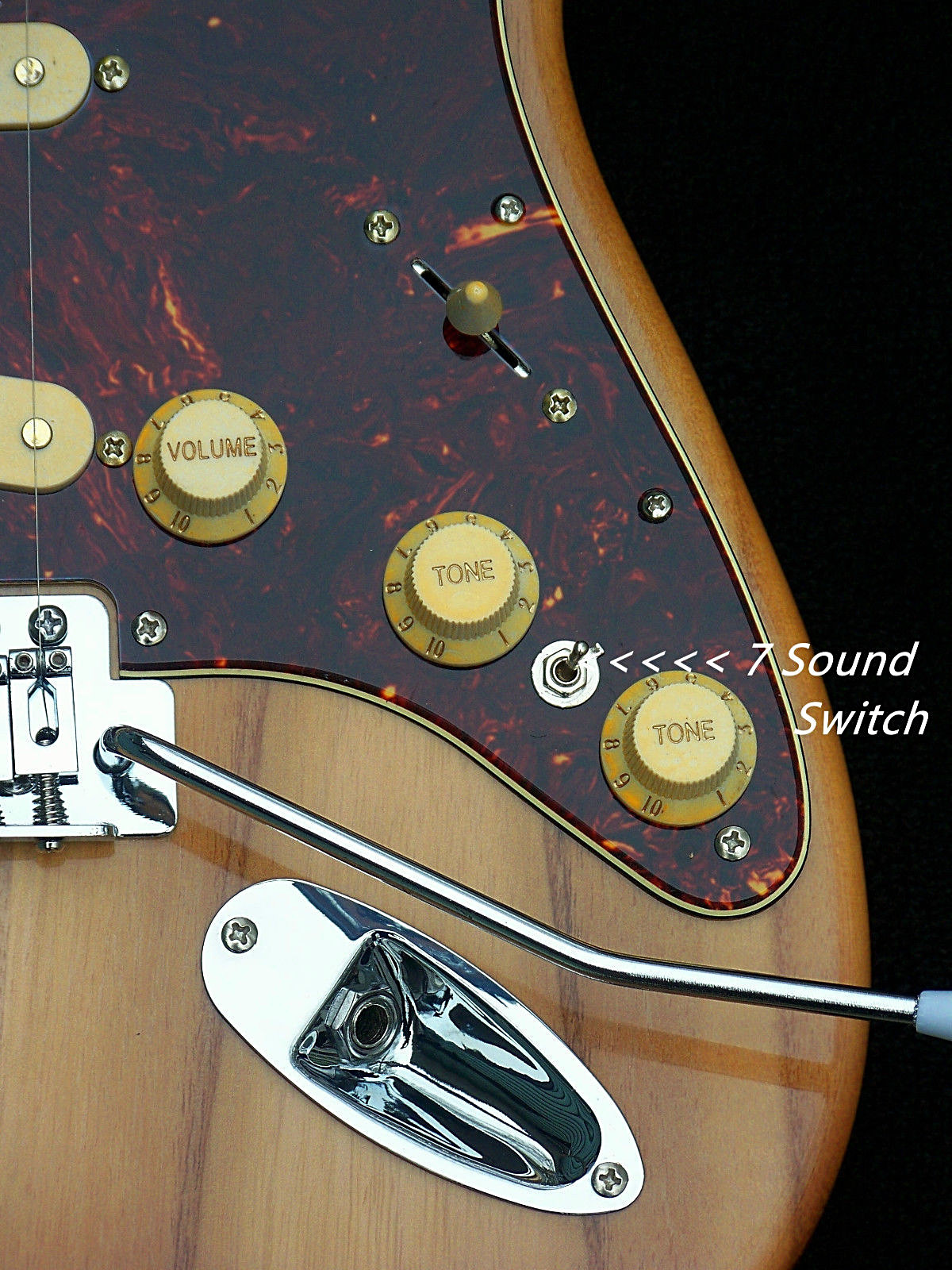
First let's look at the physical differences in the configurations. The Stratocaster and Telecaster have similar electronics. They each have a master volume control, but where the Tele only has one tone control, the Strat has dedicated tone knobs for the middle and neck pickup but NONE for the bridge pickup. I always wire it so all three pickups have a tone control. The player then has the option to take the "edge" off of any shrill sounds that degrade the music. More about that in a minute. The Tele has a 3 position blade switch as follows:
3-way switch
position 1 Bridge pickup alone
position 2 Bridge + Neck in parallel
position 3 neck pickup alone
The Strat has a 5 position blade switch for more tones, but then when we add the Haywire Seven sound switch it will add two more tones not available on any commercial Strat built by Fender.
5-way switch standard pickup selections Your 2 new selections with the 7 Sound Toggle switch:
position 1 Bridge pickup alone bridge + neck in parallel
position 2 bridge + middle pickup in parallel all three pickups in parallel
position 3 middle pickup alone
position 4 middle + neck pickup in parallel
position 5 neck pickup alone
So, why does the Strat lack a tone control on the loudest most piercing pickup? Is it a defect? No, just a design that was only meant to please the inventor, Mr. Leo Fender.
Leo wanted a pickup position that sounded similar to a steel guitar. So now, the bridge pickup selection has no tone control wired to it whatsoever and no one at Fender Corp. since then has seemed to notice. They have failed to hear what guitarists for years have asked. Can we simply have a tone control on our bridge pickup? I do it with all of my Strats. I also add a toggle switch which will activate the neck pickup in any position of the Strat 5 way switch.
The switching, however, is another story. The Telecaster has always carried a three-way switch, but after guitarists found that they could get more tonal versatility by jamming the Strat’s original three-way switch in between the first and second position and second and third position, Fender outfitted it with a standard five-way selector.
The Telecaster guitar typically has two single-coil pickups, with the bridge pickup being wider and longer, heavier, more magnetics and more windings than its Strat counterpart which can give it a more powerful tone. I can add a Tele bridge pickup to a Strat (which I have done on my own guitar) to slip between Tele and Strat sounds.
It was an idea born out of many requests from Branson and Nashville Show players to give their guitars access to BOTH Strat and Tele tones so they wouldn't have to keep changing guitars during a fast paced show. Finally, whatever the difference between the two sounds it can be compensated for and ultimately eliminated giving a player full use of both The Tele and Strat sound spectrum with an added TONE control on the bridge and the 7 way toggle switch.
Rick Mariner
3-way switch
position 1 Bridge pickup alone
position 2 Bridge + Neck in parallel
position 3 neck pickup alone
The Strat has a 5 position blade switch for more tones, but then when we add the Haywire Seven sound switch it will add two more tones not available on any commercial Strat built by Fender.
5-way switch standard pickup selections Your 2 new selections with the 7 Sound Toggle switch:
position 1 Bridge pickup alone bridge + neck in parallel
position 2 bridge + middle pickup in parallel all three pickups in parallel
position 3 middle pickup alone
position 4 middle + neck pickup in parallel
position 5 neck pickup alone
So, why does the Strat lack a tone control on the loudest most piercing pickup? Is it a defect? No, just a design that was only meant to please the inventor, Mr. Leo Fender.
Leo wanted a pickup position that sounded similar to a steel guitar. So now, the bridge pickup selection has no tone control wired to it whatsoever and no one at Fender Corp. since then has seemed to notice. They have failed to hear what guitarists for years have asked. Can we simply have a tone control on our bridge pickup? I do it with all of my Strats. I also add a toggle switch which will activate the neck pickup in any position of the Strat 5 way switch.
The switching, however, is another story. The Telecaster has always carried a three-way switch, but after guitarists found that they could get more tonal versatility by jamming the Strat’s original three-way switch in between the first and second position and second and third position, Fender outfitted it with a standard five-way selector.
The Telecaster guitar typically has two single-coil pickups, with the bridge pickup being wider and longer, heavier, more magnetics and more windings than its Strat counterpart which can give it a more powerful tone. I can add a Tele bridge pickup to a Strat (which I have done on my own guitar) to slip between Tele and Strat sounds.
It was an idea born out of many requests from Branson and Nashville Show players to give their guitars access to BOTH Strat and Tele tones so they wouldn't have to keep changing guitars during a fast paced show. Finally, whatever the difference between the two sounds it can be compensated for and ultimately eliminated giving a player full use of both The Tele and Strat sound spectrum with an added TONE control on the bridge and the 7 way toggle switch.
Rick Mariner
Friday, April 27, 2018
Benefits Of Wider Fret Boards Include: Better Action, Pull-offs, No Crowded Fingers

Haywire Custom Guitars Custom shop has been in operation for many years and we are experienced in the needs of guitar players. We try and address issues they don't know how to address. One of the ways we accomplish this is to add custom necks onto guitars with features only seasoned guitarists would understand and appreciate.
For example, we'll add a neck with a wider fret board so that the guitar player would have more room to move around on the guitar without the feeling of being crowded. We can only however go so wide and still maintain decent string alignment with the pickup pole pieces. As the nut widens, so also does the string spread at the heel of the neck. To make it all work, we widen the fret board over a 16th of an inch on either side. This results in a normal string to fret board edge margin over the full length of the neck.
The benefits of the wider fret board include but are not limited to: better action, better pull-offs, no crowded fingers when chording, easier finger placement, clearer notes and more real estate on the top of the fret board for the guitarist to play. It is just a building technique to add comfort to playing a guitar that you cannot get from "off the rack" instruments in a music store. There are real benefits to a custom extra wide necks and a good luthier who understands what techniques to apply to an instrument so it will be easier to play. We do it all the time. They know that guitarists need to improve their playing and anything they can do to facilitate that will be appreciated. We think about and apply these techniques every day in our shop for our customers.

Tuesday, April 24, 2018
Guitar Pickups are Akin To Microphones So You Need To ........
Your guitar pickups are similar to microphones with subtle differences and some are made to be snugged right up to the strings where they will perform much better. I set them close, so they will scream, and will also hear a great deal more that other pickups placed farther away. Some players use: Dimarzio, Duncans, Bareknuckle and others with their humbuckers bearing huge magnets. They are more powerful but in what way? They need to stand off from the strings for magnetic and vibration resistance reasons. But the biggest reason is NOISE. Big fat heavy pickups are noisy. Guitar strings will get pulled out of tune when they sense too much magnetic force in their orbit. A big fat heavy magnetic humbuckers will exert a lot of downward pull.
Why? Simply because it hampers string sustain and bends the strings by pulling downward on the strings. A downward pull on an in tune string equals, "out of tune" strings. Do you want to be in tune? Would you like more sustain or less? If you'd like more sustain then use a low wound pickup or one with a weaker ceramic magnet rather than an Alnico-2, 3 4 or 5.
Just because the magnet is weak doesn't mean you have a wimpy pickup. It just means you have to handle it differently. What you do is to raise the pickup all the way up (not so far that the strings bang the top of the pole piece) just below the strings where it can hear everything. You want an accurate reproduction of the sound.
What I'm suggesting is akin to a singer standing close up to the microphone versus singing 2 feet away. You want to be heard Right? Why sing so far away? Same with a good, well made low power pickup for your guitar. Get it CLOSE!
The even pole piece pickups are generally preferable to the staggered pole when trying to accomplish this better sound approach to getting your guitar heard.
Many players select staggered pickups simply for aesthetic reasons. This is great as long as you're just doing photo sessions and not really playing the guitar. Most players have no idea when to apply the use of a set of staggered pickups. That is why you're here! The reason to use that kind of pole stagger is when the radius of the neck is especially deep. The necks in the 1940's and 1950's required these because the radius was extremely curved with a deep radius. A well set up guitar will have a string radius matching the radius of it's particular fret board. At an extreme 7.25 Radius the pole pieces on the D and G strings were are far away they can not be heard very well (have you heard this somewhere before?). To solve the problem back then, a few of the poles were extended to be able to reach just under the strings to BE HEARD. Thus the staggered pole pickup was born. YAAAAY! It doesn't mean however that you need to run out and get a set. Most fret boards these days have a radius of 12" and higher. There is no need for the staggered profile set on newer guitars now otherwise-some of your strings will not be heard. Am I repeating myself? Good, you need to know this.
The important take away is get the right set of pickups. get the right pole piece setup and set your pickups at the proper height. Then get back with me and let me know how much better your guitar sounds.-Rick Mariner
Saturday, April 21, 2018
Why Block A Tremolo On A Guitar?
Why Block A Tremolo On A Guitar?
How to "Deck" Or Block A Tremolo On An Electric Guitar?

Haywire Double Fat Plus in Antique White with Blocked Tremolo
Floating Tremolos Equal Out of Tune Guitars.
After playing a Guitar with a blocked tremolo-you'll love it! Why? Well simply put-if your not playing a guitar with an advanced system like the Floyd Rose Tremolo then chances are it's the 70 year old Fender floating tremolo bridge technology your using. So, why will you love playing a guitar with a blocked trem? You'll be in tune more of the time and no one in the band will give you a hard time anymore!
Problems with a “Floating Tremolo Bar” are as follows:
1-Strings almost never return to "zero" after a dive bomb.
2-If one string breaks, the rest of strings go out of tune because of tension change.
3-Intonation is less inaccurate and takes much longer to adjust.
4-Bending just “One String” will cause other strings to go out of tune.
5-Other musicians playing with you most likely will not be in tune with you.
How do we block a trem in the Custom Shop and why?
Blocking the tremolo requires pulling of the inertia block with the tremolo springs closer to the back wall of the trem cavity to prevent it from moving. It is accomplished by tightening the screws at the “claw” and it pulls the springs tight. This makes the bridge behave more like a hard tail bridge, eliminating common headaches. Remember this unit design has not changed since the 1940’s however players have changed!
It’s much easier to decipher an out of tune guitar in these technical times with the advent of our ”electronic tuners” not around when the tremolos were invented.For those who are purists and want to keep their instruments in “collectible” condition then have no fear. The process is not permanent. Eric Clapton blocks all of his guitars and he's got some real vintage models.
The electric guitar ‘Floating” trem bridge is only “blocked” when the screws are tightened under the tremolo cover plate in the back of the guitar body. If done properly the springs will be so tight that the trem will not move thereby rendering it blocked. The re-sale value is much better if you don’t physically change anything that can’t be reversed since lots of players still want a trem or whammy bar on their guitars. Fortunately there is another benefit. There is more sustain without the floating tremolo. If it’s blocked and it stays in perfect tune and it’s not permanent or invasive to your instrument and it’s completely reversible-then what’s not to like about it? Go ahead and block your trem!
Ordering From Haywire Custom Guitars
If you would like to order this or any other custom guitar, please contact us and we will be happy to discuss your guitar needs.
Blog Home
Friday, April 20, 2018
"Create a Mood" With A Good Guitar Setup!

A: There should be no need to alter your playing technique as you move around on
your guitar.
A pro guitar neck set-up feels great and is consistent all the way up the neck and promotes effortless playing. It's almost impossible to get a good set-up when you buy off the rack in a music store. WHY? Simply because they don't know who is going to buy it and setup requirements are different for every player, so they do nothing. OK, I get it and fully understand why they do that. However they usually don't have a good setup tech on staff the very day you walk in. Know what you want! Take some ownership of knowing what you need to play well.
Then pursue it vigorously.
A **Custom** guitar set up is what you want and is routinely done in The Haywire Custom Shop to give players maximum breadth and depth of hand freedom to play how they want to play when playing at their best.
The Custom guitar shop is where to go. It's not really a players responsibility to know how to do a setup, be he needs to know himself and his playing well enough to be able to describe the feel and know when he feels it. Much like music itself. Your setup should, "Create a Mood" for you. We take pride, time and care in our set up work so the player is very pleased and surprised with the feel, action and performance of our very fine instrument setups-before he leaves the shop.
No waiting, we do it right away and hand it back over to the player for approval before he or she leaves. Then we guarantee it. Sometimes finding your setup requires time, testing and patience especially if you are a new player. You know something is wrong, but can't verbalize it in an discerning manner. In addition to callouses, good setups are a necessary roadblock to get familiar with and loving playing a guitar. Great guitar feel needs to be chased down until it's caught. Find your setup. Know what you need. Relay it properly. Have it done. Begin playing much better.
We encourage you to write us and let us know what you think about setups. Guitars are set up, intoned perfectly so any note or chord is in tune anywhere on the neck at a bare minimum. In a great one-the FRETS will also feel smooth, silky and you'll feel the emanation of great tone because they have been leveled, re-crowned and polished. The fret now becomes a great base for the notes. The truss rod and neck angle are in synergy for that particular guitar because each guitar requires it's own custom setup as they are all different, just like people. Guitars need us to pay specific attention to their idiosyncrasies as instruments and don't want us to judge them by just how they look but how they CAN play if you help find their, "Sweet-spots"..... Find your Guitars potential. Find the sweet-spot, or let a good tech do it. Then play great!
Install a new set of your favorite strings for your feel, before judging any newly setup guitar. In the shop, guitars have been played and thoroughly tested at the Haywire Custom Shop, South Carolina. When properly set up an instrument there is no need to alter your technique as you move around on your guitar. Is your action the same on the 12fth fret as on the 1st fret?
Your neck set up must feel comfortable and consistent all the way up the neck for you to get comfortable with your best playing. You absolutely need to be pleased,
surprised and very comfortable with the feel, action and performance of your
instrument setup. Are you thrilled with it? You should be. Find out what you're missing and go get a great setup for your guitar to match your style,playing comfort and level of expertise. Talk to your tech today! https://www.haywirecustomguitars.com/buy-it-now/
Blog Home
Blog Home
Monday, April 16, 2018
This Is An Article About Guitar Shims For Perfect Neck Matching And Alignment
Q: Is there a problem with my neck pocket I see something in there?
A: No problem there. It's a shim often used by Haywire, Luthiers and techs for years.
It is necessary in achieving very low action. It's part of the correct process in guitar building, setups or perfect neck matching and alignment.
specifically:
If you'd like to learn more about the guitar building process
just go to HaywireCustomGuitars.com and click on BLOG for over 100 articles here:
http://www.haywirecustomguitars.com/blog.html
What is the purpose of a neck shim for a guitar?
A shim when referring to guitar builds is for a thin spacer with specific measurement particular to one guitar only. A shim for one guitar is not interchangeable with another guitar.
The standard terminology used by luthiers for a thin wedge under a bolt-on neck is a shim.
What is the purpose of a neck shim?
To adjust the angle or pitch of the neck.
Why would you need to adjust the angle or pitch of the neck?
Let’s say you replace the neck on your guitar. You install it, level the frets, re-crown, set the neck on all 4 axis, then add the two "E" strings clamp it, adjust your truss rod for proper bow, and then if notice that the height of the strings is high. You also notice that no matter how low you adjust the
saddles, the strings are still sitting way too high above the frets.It’s at that point you
need a neck shim to change the angle so you can adjust strings to your desired string height. Now, it's time measure for a shim. It's like visiting a tailor for a final fitting.
Where is a shim placed?
Under the heel of a bolt-on neck at the bottom or at the edge of the neck pocket. It's called a reverse shim at the other end of the pocket.
What can be used for shim material?
There’s a long list of materials that could be used. You could use a guitar pick, a thin piece of veneer, a business card, a thin sheet of metal, however: HVAC silver sealing tape is one of the best choices. It is preferable to use a material that can but cut to fit across the width of the neck easily, and/or layered and won't degrade with age. Shims are also sold by Fender and Stewart-MacDonald.
Is it always required to use a neck shim whenever fitting a new bolt-on neck?
No. If after installing the neck and adjusting the truss rod you see
better action possible and you can set your action with string height better then use a shim.
You will need one, because the likelihood of a new bolt-on neck fitting exactly right just doesn’t happen. It's up to us to "make it happen".
Why is a neck shim so often needed for new neck installations?
Because wood is unpredictable in how it will settle in once installed.
No two necks fit exactly the same on a body.
As long as the bolt-on neck is installed properly and has a
good, snug fit, the shim does not affect sound whatsoever.
Is it true some builders purposely put in a shim gap for tonal purposes?
Some builders do believe that the gap created by a shim actually adds in a
special tonal quality and keeps the angle correct all in one operation.
Rick Mariner-Haywire Custom Guitars, Custom Shop

A: No problem there. It's a shim often used by Haywire, Luthiers and techs for years.
It is necessary in achieving very low action. It's part of the correct process in guitar building, setups or perfect neck matching and alignment.
specifically:
If you'd like to learn more about the guitar building process
just go to HaywireCustomGuitars.com and click on BLOG for over 100 articles here:
http://www.haywirecustomguitars.com/blog.html
What is the purpose of a neck shim for a guitar?
A shim when referring to guitar builds is for a thin spacer with specific measurement particular to one guitar only. A shim for one guitar is not interchangeable with another guitar.
The standard terminology used by luthiers for a thin wedge under a bolt-on neck is a shim.
What is the purpose of a neck shim?
To adjust the angle or pitch of the neck.
Why would you need to adjust the angle or pitch of the neck?
Let’s say you replace the neck on your guitar. You install it, level the frets, re-crown, set the neck on all 4 axis, then add the two "E" strings clamp it, adjust your truss rod for proper bow, and then if notice that the height of the strings is high. You also notice that no matter how low you adjust the
saddles, the strings are still sitting way too high above the frets.It’s at that point you
need a neck shim to change the angle so you can adjust strings to your desired string height. Now, it's time measure for a shim. It's like visiting a tailor for a final fitting.
Where is a shim placed?
Under the heel of a bolt-on neck at the bottom or at the edge of the neck pocket. It's called a reverse shim at the other end of the pocket.
What can be used for shim material?
There’s a long list of materials that could be used. You could use a guitar pick, a thin piece of veneer, a business card, a thin sheet of metal, however: HVAC silver sealing tape is one of the best choices. It is preferable to use a material that can but cut to fit across the width of the neck easily, and/or layered and won't degrade with age. Shims are also sold by Fender and Stewart-MacDonald.
Is it always required to use a neck shim whenever fitting a new bolt-on neck?
No. If after installing the neck and adjusting the truss rod you see
better action possible and you can set your action with string height better then use a shim.
You will need one, because the likelihood of a new bolt-on neck fitting exactly right just doesn’t happen. It's up to us to "make it happen".
Why is a neck shim so often needed for new neck installations?
Because wood is unpredictable in how it will settle in once installed.
No two necks fit exactly the same on a body.
As long as the bolt-on neck is installed properly and has a
good, snug fit, the shim does not affect sound whatsoever.
Is it true some builders purposely put in a shim gap for tonal purposes?
Some builders do believe that the gap created by a shim actually adds in a
special tonal quality and keeps the angle correct all in one operation.
Rick Mariner-Haywire Custom Guitars, Custom Shop

Saturday, April 14, 2018

Friday, March 30, 2018
Installing A Bolt-On Guitar Neck
Special Re-print
at: Haywire Custom Guitars Inc.
If a bolt-on neck will drop in a body with a bit of room to align it right or left that's a good choice so far. Generally when I prep or order a neck I'll fill the heel screw holes. If there are holes already drilled in the neck heel in it then you can try to use them but never trust holes on necks drilled by someone else. It's always best for the most successful project to drill your own holes in the neck heel (and have a depth stop so you don't drill through the other side and blue tape works well). The optimum way with the least headaches is to simply dowel the holes. Use wooden Bar-B-Que skewers then add glue in the hole break them off in the holes, sand smooth and you ready to go. Now with a fresh clean surface to work with you can move to the next step. So let's go over how to get it PERFECT. I have used this method in hundreds of neck installs and it is the best technique. As follows and note: You'll need to add the "two E" strings to the neck before final installation on body to set the string margins exactly but we'll get to that in a minute.First: Tape the neck plate onto the back of the body vertically and horizontally leaving the holes exposed. Next, using a "C" clamp, add the neck, body and neck plate together and place a thin piece of wood in each jaw to protect the guitar fret board then tighten. Snug it but not too tight. Now, add the two outside "E" strings. This is where a very slight gap between the sides of the neck and body comes in handy and extremely helpful.
Setting the margins is a critical operation, however not difficult. Once you have clamped the neck and added the 2 outside strings, face the guitar and move the neck right or left to get the string margins set perfect on each side of the fret board all the way down.
Once this is done then you can enter the final installation steps. Take care to "mark the screw hole depth" on the drill bit with tape bit so as not to drill through the front of the fret board. Ready? Tighten the clamp, spin the guitar around and drill one hole. Add the first screw (some liquid dish detergent always helps the journey of the screw threads to enter smoothly), spin the guitar back around to check your string margins again and the neck hole alignment within the back plate. If the neck needs adjustment then tap hard on the head stock with the heel of your hand to get everything aligned again. Now you're ready for the rest of the holes to be drilled.
It is not a difficult process but methodical and deliberate. You follow this on EVERY install and your necks will all come out with the perfect amount of margin space between the outside strings and the edges of the fret board. Once installed the neck may need shims to tilt it either up or back. Be sure and add shims if necessary. They are sometimes critical to eliminating string "Buzz".
This technique will assure that everything is straight and true. The small gap will help to accomplish this and give you enough room to set the margins exactly right on each side. Let me know if I can assist further. Also please write us from the Haywire Custom Guitars website and let us know what you're interested in. And, of course we can add any neck to any body for you.

Saturday, March 24, 2018
The Mystery of "Roasted Maple" Guitar Necks

Be careful when adding a "Roasted Maple" neck on to a guitar body.
While there are advantages such as being less expensive when no finish is required and the fact that the roasting process brings out a beautiful caramel color in the wood. There are drawbacks.
Remember the nature of "Roasted Maple" is to be very brittle. Therefore, look closer at the roasted neck than you normally do other necks, specifically the screw holes. It's very interesting but can be a difficult problem if you are not aware of the characteristics of the roasted wood. Screw threads on the neck plate screws can strip out in the neck holes. It's caused by the roasted wood being so brittle that the insides of the holes are much more prone to strip out versus an non-roasted Maple neck. If you have ever worked with 100 year old wood then you know what you're dealing with. Roasting ages wood significantly.
The
stripping of the brittle wood screw threads inside the holes cause the screws to loosen their grip. Strings will pull with lots of pressure when in tune and can cause the screws to slip and the neck to pull away from the
body-thus lifting the strings off of the fret board.
This
will cause higher action and make it much more difficult to play. Soon you will be "Fighting with your guitar", Eventually, the action will to be way too high to play.
When I set it the action on this guitar the last time before shipping, it was very low however the vibration and bumping of travel plus the tension of string pulling can cause the very slow release of the screw threads, screw slippage and thus higher action.This is all very imperceptible at first but will accelerate over time and causes lots of playing problems.
I sent back to a customer, a Roasted Maple neck, he asked me to add to a body. When he got it back he told me it was difficult to play. The whole "difficult to play" problem was very puzzling for me. It went out playing great. Since he didn't change anything I needed to look further into what could have happened. He sent it back and I went to work. I took the whole guitar apart and studied every piece to try and track down what happened. Then, I remembered, the nature of "Roasted Maple" is to be very brittle.
After I discovered this could be an issue not widely known, I filled the neck holes with some small dowels to decrease the size and increase the grip of the screws.
Next, I found some screws with a larger diameter thread to further decrease the hole size.
With those two changes it made the holes extremely tight and much less prone to slipping and more able to keep the neck where I wanted it for great low action.
I
re-assembled the entire guitar, re-aligned the neck, oiled the fret
board to lessen the loss of moisture which causes even more brittleness. leveled the frets, polished them, added new strings, lowered the action more, re-set the intonation, tuned it and tested and it plays just great. So with all of the changes bearing in mind the characteristics of the wood-I think the mystery has been solved. As always we can add any neck to any body for you.
Rick Mariner
Subscribe to:
Comments (Atom)